
What: Brief of the Problem: To Provide Foundation System for 70 R Bridge at Challenging Terrain:
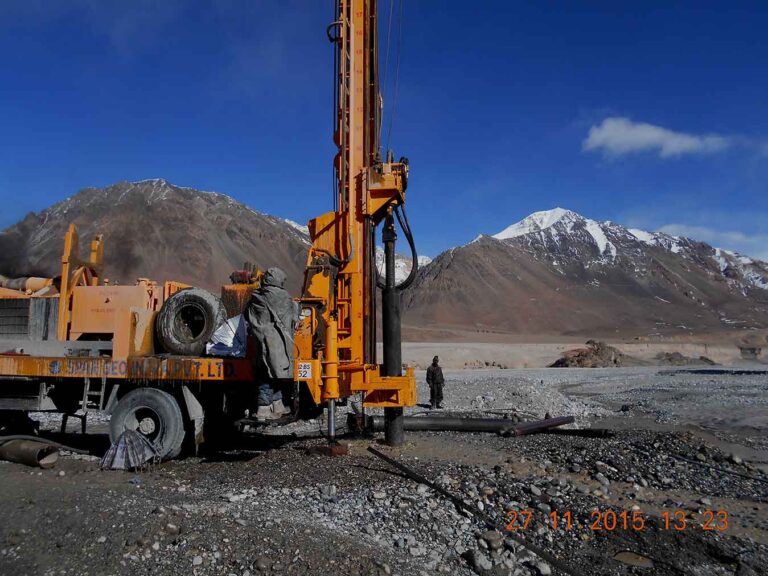
In Leh- Ladakh area, there is one important road leading to china’s border in which there crosses the Shyok river width around 500 meters, and there was an urgent requirement of class 70 R Bridge. The site at KM 150.00 has desert terrain located at an elevation of 14700 feet above MSL with glacier valleys and during summer season glacier melts, which increases the water level of Shyok River and damages the road which ultimately leads to difficulty in transportation. The terrain in such areas is up to very high altitudinous and
deficient in oxygen in the atmosphere. The temperature touches minus 30 degrees centigrade, and consequently, snowbound areas, including frozen river beds, are frequently encountered. There are a number of glacial deposits leading to the worst environmental condition allowing hardly three to four working hours daily. Site remoteness was the issue.
The approach to this location is connected by a single road axis, which was 300 Km away from the nearest habitat of Leh city. The river flows through the difficult terrain of Ladakh valley, and this area is prone to ‘Glacial Lake Outburst Floods’. These constraints demand the construction of permanent structure for inland road connectivity across the Shyok River. The bridge piers constantly remain in the threat of bed erosion due to the turbulence effect around the pier periphery. Mountainous terrain possesses vital challenges, maximum difficulty at the site due to difficult approaches, limited accessibility, larger time for deployment of resources, long movement across a number of high mountain passes, which ultimately affect the logistics and communication hampering both the sustenance and maintenance efforts.
Morphology of River Bed:
The site conditions comprises of varying thickness of glacial overburden soil with cobbles and boulders. It has a huge quaternary deposit predominantly. The general strata comprised of sand mixed with boulders of size 40mm to 200mm. Borehole investigation showed that at only one abutment bedrock was at 12m and at two piers the bedrock encountered below the 20m, remaining having almost river sand with gravel, soil classification of SW- well-graded sands, gravelly sand, little or no fines and GP- poorly graded gravels, gravel-sand mixtures, little or no fines. The entire site soil condition was the river born material (RBM) with glaciers (ice).
How: Strategy to Resolve the Issue:
A detailed discussion about the feasibility of the appropriate foundation type for this challenging region was made with BRO officials. Several options were deliberated for the possibility of the foundation for the proposed bridge. At the first stage for the foundation purpose of the bridge, such as deep (well, pile, etc.) and shallow foundations (open cast foundation). Suitability of well foundation was not suitable due to the higher water level, which restricts the accessibility for execution. In the case of pile, the requirement of
mobilization of heavy machinery, which is not possible because mobilization of these heavy machines will contribute to further stresses. In the case of a shallow foundation, the concrete is not setting due to the presence of a high water table; dewatering is required continuously, which is not considered to be a good option.
The new technique was proposed to transfer of superstructure load to the desired firm bed level using vertical and battered micro piles. To take advantage of Micropile and strengthen its surrounding area of Micropile periphery, feasibility and design of TAM grouted Micropile was then investigated. Design and analysis were carried out to achieve the axial capacity and lateral load-carrying capacity. TAM grouted micropile constructed by drilling a borehole using Pneumatic Machine, placing steel reinforcement, and grouting the hole. Tam grouting having various benefits such as injections can be carried
out in various stages, and different mixtures can be injected for each grouting stage. This permits better penetration of the fine voids after the big ones have been closed.
More permeable soil layers can be sealed first regardless of the order of injection level, which prevents loss of high-cost, low-viscosity grouts The abutments were designed with 69 piles. Out of these 69 piles, 25 piles at the center were vertical piles, and at the outer 44 piles were raker piles. The design for each pier has been finalized with a pile group of 49 piles. Out of these 49 piles, 25 piles at the center are vertical piles, and at the outer 24 piles are of raker piles. Each micropile of 273 mm diameter socketed deep 21 meters into bed soil. Grouting was carried out using cement (53 grade OPC) with an addition of
1% special admixture of the total weight of cement to increase the strength of grout mix with the help of double packer for 1.5 m section which helped to maintain almost a uniform thickness of grout along the length.
Pile Load Test:
The finalization of the project has to be done by verification of field tests.
Pile Load Tests as per are: 2911- part four were conducted for this purpose
Vertical piles – 8 no’s
Lateral load tests on vertical piles – 6 no’s
Group Pile one battered & vertical Pile – 2 no’s
Axial Load Test was conducted for Depth of Pile: 21m
Applied Axial load: 80tonnes, Rate of loading: 20% of Ultimate load
For lateral load test, Initial Pile load test for Ultimate Load: 2.5 ton
Difficulties faced during Execution:
Since the site was located in the region where climatic conditions are extreme and due to temperature variation causes health issues to the workers. While carrying out the plate load test, sometimes the test was aborted because of floods. The regular machines were not capable of executing work in such a climate, so machines capable of working in low temperatures were imported by us. While grouting the grout setting was also tough to achieve due to the presence of a water table.
Special Technology used for Execution:
For grouting of micropile Spar Geo suggested Tube-A-Manchette technology. A Manchette tube is a PVC or metal pipe in which rubber sleeves cover holes that are drilled in the pipe at specific intervals. The sleeves open when pressure is applied, which allows the spreading of grout outside of the tube; these sleeve doesn’t allow grout to come inside. The grouted area got increased by using a double packer. This technology helps
to reduce the magnitude of settlement due to increased confinement and friction with the surrounding soil.
Achievement:
We were successful in carrying out grouting by using TAM technology effectively on the site where harsh climatic conditions prevail. Our machines and workers adapted to the climatic conditions and carried out the execution work for the bridge foundation efficiently. With a limited working period available, the bridge was completed in 18months. The project was inaugurated by our Honourable Defence Minister, Mr. Rajnath Sigh Ji, on 21st October 2019 and is dedicated to the nation.